How do you know if your educational platform is really working?
A good platform can transform the way a school teaches. Getting there takes measuring what matters and having teachers willing to change.
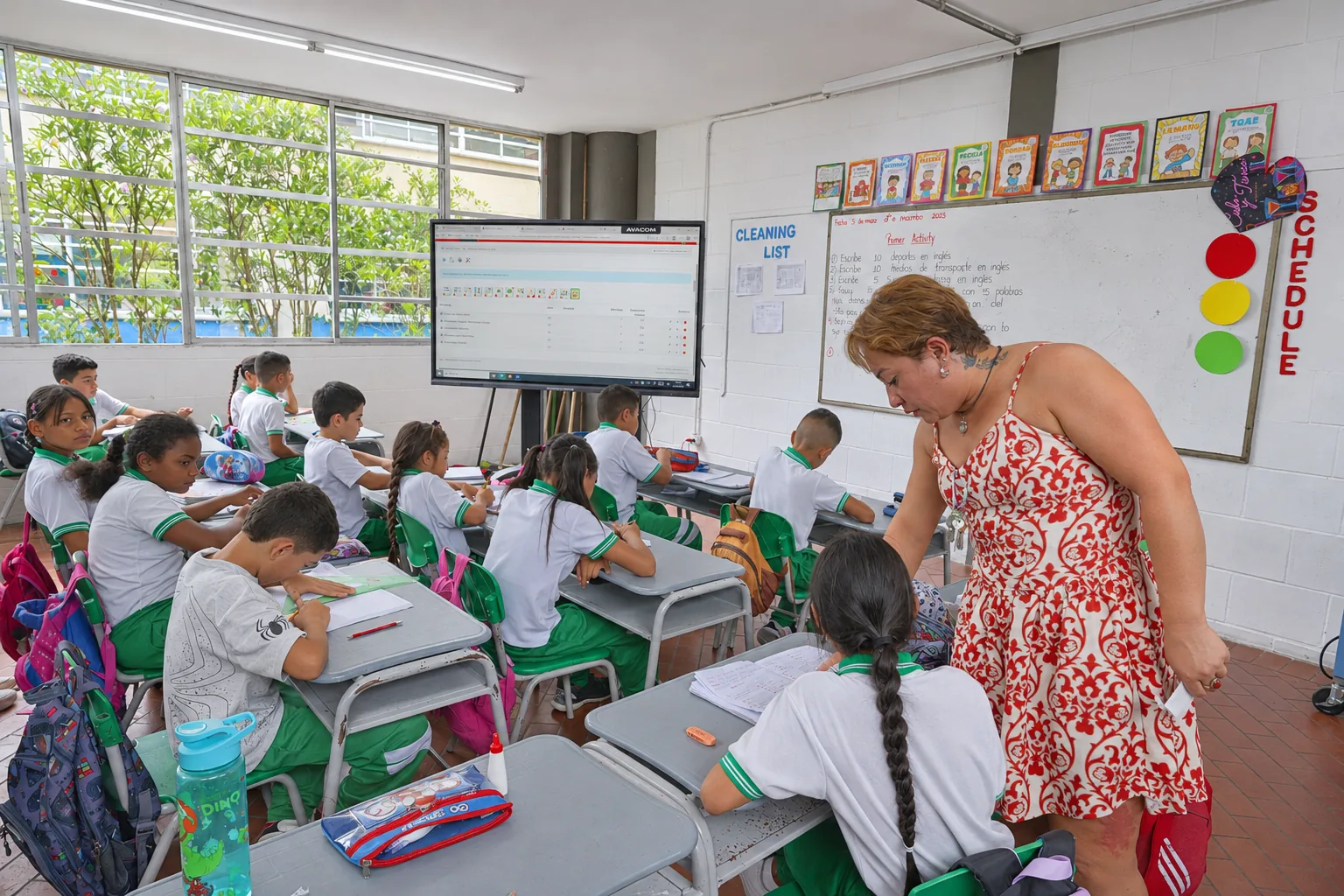
Measuring a platform by logins says little about real learning.
Technology pays off when it changes the way teaching happens, not just when the devices are there.
A trained, supported teacher is the ingredient that brings the platform to life.
Five questions help you tell whether it is really working.
There is one figure almost every school checks first when it wants to know whether its educational platform is working: how many students logged in this week. It is easy to get, fits on a slide and feels reassuring. It also says very little.
A student logging in means they opened the door; whether they stayed, understood, or came back the next day because they wanted to is still unknown. Measuring a platform by its logins is like measuring a library by the number of people who walked through the entrance.
What the evidence says
Research agrees on something worth keeping in mind: technology truly pays off when it changes the way teaching happens. When the OECD (2015) cross-referenced PISA results with computer use in schools, it found that the difference lay in how computers were integrated into lessons rather than in how many there were.
Escueta et al. (2020) reviewed dozens of experiments across different countries and found especially promising results for software that adjusts exercises to each student's level, above all in mathematics. That is good news for schools: the right tools can bring every child closer to teaching tailored to them. And all of those cases share a common starting point: someone in the classroom decided to use that information to teach differently.
The other ingredient: teachers willing to change
A platform can be excellent and still sit idle if the teacher keeps teaching the same way they did ten years ago. Not for lack of will: changing the way you teach takes time, confidence and support.
Ertmer and Ottenbreit-Leftwich (2010) studied what makes a teacher genuinely integrate technology into their practice and found that technical knowledge is only one part. Just as important, or more so, are teachers' confidence in themselves, their beliefs about how people learn and the culture of their institution. A teacher who feels supported and sees results in their students is encouraged to try; one who feels judged by the tool protects themselves from it.
That is why asking whether a platform works is also asking about the teaching staff. Did they get hands-on training, close to the classroom? Do they have room to make mistakes and try again? Are there colleagues to share what works with? When those conditions are in place, the software stops being just another tool and becomes a new way of teaching.
Five questions for the next committee meeting
The first: do students come back without being asked? Voluntary use, on tasks that are not mandatory or outside class hours, is one of the most honest signs that the content is useful to them.
The second: do teachers use it for more than uploading files? When a teacher builds activities, reviews results and adjusts their lesson based on what they see, the tool is doing its job.
The third: is there evidence of progress over time? Comparing the same group's performance at the start and end of a term, in the competencies the platform is meant to strengthen, says far more than any activity dashboard.
The fourth: can you see who is falling behind? A good platform shows which students are not progressing and which topic they are stuck on. That information is worth its weight in gold when a teacher uses it to sit down with that student the next day.
The fifth: does it work when conditions are not ideal? A classroom without a stable connection, a large group, a teacher who has just arrived. The platform that also performs in the real school is the one worth having.
Listening to the teacher
Numbers help, and teachers know things that do not show up in any report. They know whether their students discuss more, whether they ask better questions, whether they take on an exercise they used to avoid. A fifteen-minute conversation with three teachers from different subjects can reveal more than a month of metrics. It is best held with open questions: instead of “Do you like the platform?”, ask “What do you do in class now that you couldn't do before?” The answer says a lot about the tool, and even more about the person using it.
The final test
There is a simple way to tell whether a platform is working: imagine it disappears tomorrow. If teachers shrug and carry on as before, it has not yet found its place in the school. If one of them asks, worried, how they are going to teach Thursday's class, something is there. Technology provides the possibilities; the teacher decides what to do with them. When the two meet, the classroom changes.
At AVACOM, the eClass Digital platform makes each student's progress visible by learning objective and supports teachers with ongoing training, with an offline-first approach, so that technology translates into a new way of teaching.
References
Ertmer, P. A., & Ottenbreit-Leftwich, A. T. (2010). Teacher technology change: How knowledge, confidence, beliefs, and culture intersect. Journal of Research on Technology in Education, 42(3), 255-284.
Escueta, M., Nickow, A. J., Oreopoulos, P., & Quan, V. (2020). Upgrading education with technology: Insights from experimental research. Journal of Economic Literature, 58(4), 897-996.
OECD. (2015). Students, computers and learning: Making the connection. OECD Publishing.
常見問題
Is counting logins enough to know whether an educational platform works?
No. A student logging in only shows that they opened the door; it does not say whether they stayed, understood or came back because they wanted to. That is why logins say little about real learning.
What role does the teacher play in making an educational platform work?
The teacher is the ingredient that brings it to life. According to Ertmer and Ottenbreit-Leftwich (2010), beyond technical knowledge, what matters is the teacher's confidence, their beliefs about how people learn and the institution's culture. A trained, supported teacher is encouraged to change the way they teach.
What signs show that an educational platform is working?
Students come back without being asked, teachers use it for more than uploading files, there is evidence of progress over time, you can see who is falling behind, and it works when conditions are not ideal.