Educational software for primary vs secondary: the key differences
Sofía is seven years old and learns by touching, playing and getting things wrong without fear. Eight years later, that same girl researches, argues and manages projects on her own. An enormous transformation happens between those two moments, and the educational software that accompanies her needs to grow with her. That is why choosing the right tool starts with understanding that a primary student and a secondary student learn in very different ways.
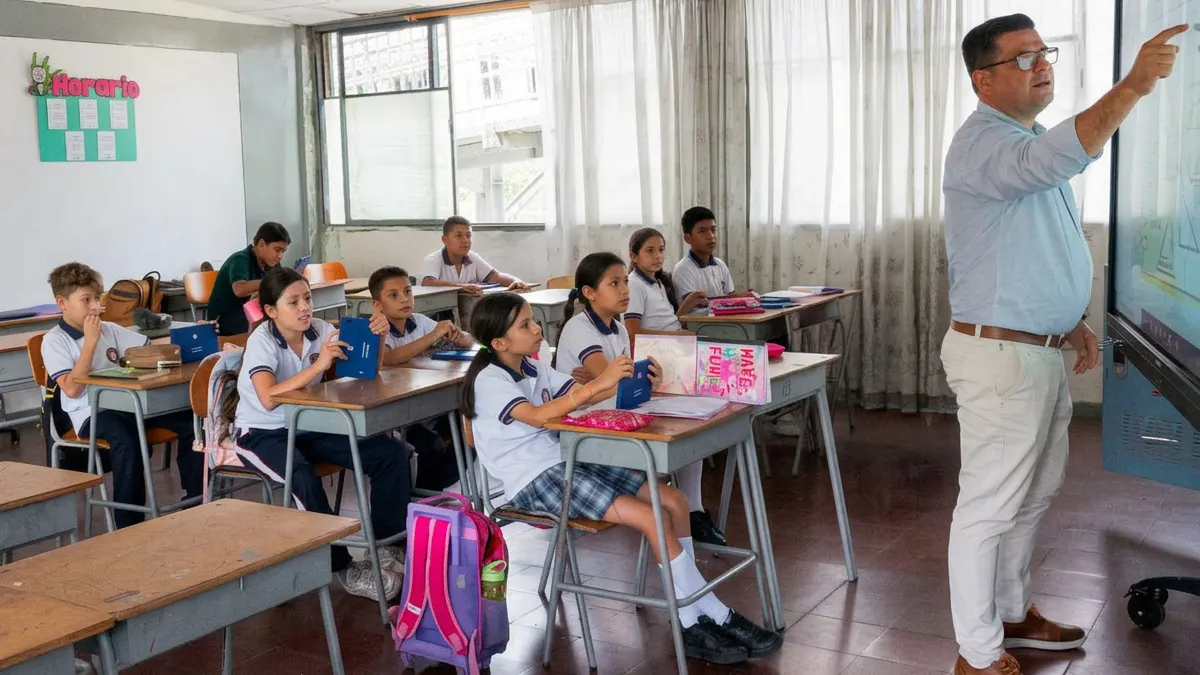
The EdTech sector moves fast, and educational software leads that evolution inside schools. Coordinators and principals evaluating an educational platform discover, in practice, that the design, the content and the way progress is measured change with age and school stage. Knowing those differences is the first step to supporting each stage well.
What is educational software and why does it change with age?
Educational software brings together the applications, platforms and digital resources that support teaching and learning inside the classroom. It spans everything from LMS platforms that organise content and assessments to the applications that come to life on the interactive display in front of the group. Its secret is that it adapts to the student's cognitive moment: the way a seven-year-old discovers the world calls for something very different from what a fifteen-year-old needs, and the educational technology that accompanies them reflects that difference in its design, its pace and its goals.
Primary: learning through play
In primary, educational software leans on sensory exploration and play as the engines of learning. This is the stage where the basic skills of reading, writing and logical thinking are built, which is why educational platforms for these ages go for visual, colourful interfaces with simple navigation, designed for small hands and short attention spans. Gamification accompanies every step, with badges and challenges that keep motivation alive.
Activities are short and combine movement, sound and image, ideal for working on the interactive display with the whole group. Teacher support is close, with simple reports the teacher reviews alongside the student, and the content reinforces habits of coexistence such as taking turns, collaborating and looking after materials. This kind of software works as an extension of play with a purpose, and its best measure of success is the enthusiasm with which children come back to the activity the next day.
Secondary: learning with autonomy
In secondary, educational software evolves towards autonomy and critical thinking. Teenagers manage projects, research and defend their ideas, so the educational technology of this stage incorporates LMS platforms with detailed tracking of grades, submissions and competencies by subject. Alongside them come simulations, virtual laboratories and STEAM projects that connect theory with real applications.
Collaborative work takes centre stage, with shared documents, forums and spaces for peer feedback. Learning analytics helps teachers and coordinators anticipate academic needs with concrete data, and preparation for standardised tests and for university life takes shape through mock exams and question banks. Here educational software becomes an ally for developing one's own judgement, managing time and mapping a solid route towards higher education.
Primary and secondary, a side-by-side look
How do you choose the right educational software?
The choice depends on three factors worth looking at together: the student's age, the institution's pedagogical goals and the available infrastructure. For primary, the priority is an intuitive educational platform that combines interactivity and holds attention through play. For secondary, the focus shifts to tracking, with analytics and content that prepare students for more demanding stages. Institutions that bring both approaches into a single digital classroom ecosystem achieve a natural transition between stages, because students and teachers recognise the logic of the platform as they move up through the grades. That continuity is, in the end, what accompanies each student's story the way it accompanied Sofía's.
Conclusion
Well-chosen educational software transforms the learning experience at every school stage. Knowing the differences between primary and secondary lets institutions invest with judgement and choose an educational platform that grows alongside their students, to build a coherent digital classroom from beginning to end.
AVACOM supports schools with an educational technology ecosystem that brings together educational software, an educational platform and a digital classroom for every moment of school development, from the first games of primary to the projects of secondary.
Usein kysytyt kysymykset
What is the main difference between educational software for primary and for secondary?
The main difference lies in the pedagogical goal: in primary, educational software reinforces habits and basic skills through challenges and gamification; in secondary, it drives autonomy, analysis and advanced academic preparation.
Can an institution use the same educational software in primary and secondary?
Yes. When the educational platform offers modules differentiated by age within a single ecosystem, the institution keeps continuity in the digital classroom and makes the transition between stages easier for students.